
Like most people, I was an awkward adolescent. I was the nerdy girl growing up. Beyond that, I was also convinced that I was unattractive. But despite all of that, I've consistently tested as an extrovert on every one of those personality tests I've ever taken. For Girl Scouts they even have a personality classification test that characterizes you as a bird: owl, eagle, dove, or peacock.
I'm a showy peacock.
Anyhow, recently my 13 year old daughter told me that I'm a flirt. And not with just random adult men, just with any men. Including her uncles and cousins. I told her that I may seem flirty but that is just my extroverted nature. I'm not flirting with my nephews. Ewww.... She disagreed. Then I asked what I'm like with women. She said that I'm outgoing with them. I think it's just perception then.
The point of this blog post is just to say that I had one of those moments with my daughter this morning and you needed the background to understand it.
Her: Mom, being the way you are, when you were growing up, did you ever have a friend who is a boy and he got the wrong idea about you and liked you?
Me: Oh honey, yes. This is going to be a problem for you.
Her: What do you do about it?
Me: You're just going to be straight with him.
Her: That's not helping.
Me: Just tell him you're not into him. That you love him like a brother. That you value his friendship.
Her: Are you still friends with those guys?
Me: Some. Not at first, but later, yes.
Is it bad of me to be a little thrilled that this is starting for her? It's scary and exciting and fun. She's starting to flex those muscles that adult women don't remember ever not having. And at that age, you're just a bag of hormones and reaction. There's no easy way to navigate these waters.
I'm sure this will be the first of many conversations we'll have like this. But I do wonder if I'll want to flense the first boy to break her heart.
Probably.
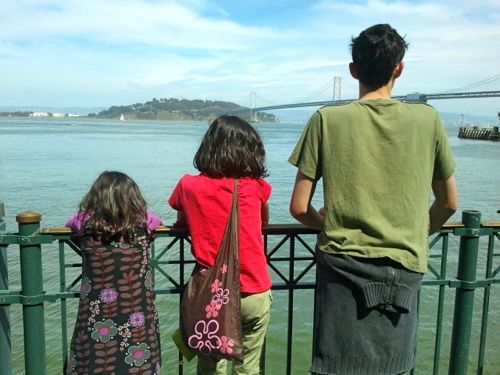
My babies
Tuesday, March 25, 2014
Flirt


Wednesday, December 11, 2013
Confucius say what?
Recently, I've been processing something that happened to me a couple of weeks ago. I was at a Girl Scout leader retreat; only adult leaders were invited from the entire region. Adult volunteers were there from several counties. However, we're in Washington and this is Girl Scouts.
I was the only Asian woman there.
I'm not saying that there are no other brownies (and by brownies, I mean non-caucasians) in the organization. Only that there weren't any at this retreat. And truth is, I don't know all their racial heritages. They all looked white to me -- but I'm not fool enough to accuse anybody of being white through and through. Especially here -- we've got lots of people who (to borrow a term from African American culture) pass as white but are actually mixed race. But to my quick assessment of the room, I was the only person who was Asian.
I had a wonderful time at the retreat. I didn't feel out of place and certainly felt welcomed by everybody there. Truly, truly, these are incredible women and they're all great volunteers. These functions are usually pretty free flowing. We teach each other new songs or crafts that we can share with the girls. We explore the different camps and take in a hike or two. We often discuss organizational changes or try to plan regional events. It sure is nice to be part of this group of women.
But then there was this one moment. The moment that I have kind of been processing for a few weeks now because I'm not sure how I could have handled it. All I know is that by every angle, I think I handled it wrong by everyone's standards. Except for my own.
I wish I could remember exactly what the conversation was. I wish I could remember why I even laughed after that first joke, but I think I did because it wasn't a joke completely out of the blue. It followed the course of the conversation so I didn't think it was strange. It was the following two or three jokes that didn't sit right with me.
In the natural course of the conversation, someone told a "Confucius say," joke. For the uninitiated, it's usually some clever turn of phrase in broken English for example, "Confucius say man who cut self while shaving lose face." But as I said, that first joke I laughed. And then the next one was said -- in that same broken English and fake Chinese accent. And the next one. And I cannot remember if there was a fourth.
What I remember was how it made me feel.
Offended isn't the right word. It is too strong a word. I wasn't offended. But I was reminded abruptly that I wasn't part of them. That I wasn't white. That my family story & my racial heritage are not theirs.
Also interesting are the reactions I got when I told my friends about the incident.
My white husband (not meanly mind you) said, "are you looking for something to be upset about?" And I found myself questioning my motivations. I wasn't *trying* to get upset, but clearly something did not sit right with me. I was trying to process.
One of my best friends, also white, said, "I never think of you as non-white. I just think of you as a person." And yes, I am a person. But I am a person who happens to be Chinese. It's not like I can change the color of my skin or the shape of my eyes or the history of my people. That too is part of my personhood.
My friend who is African American scolded me for not stopping them in the moment. He said I should have made them stop making those jokes and reminded them that I was Chinese. That those jokes were offensive. He scolded me for having laughed at the first joke. That it made me complicit and that I've somehow done a disservice to all the people in the organization and society as a whole. But that too seems too extreme. It took me days to even put a word to the moment. It took me days to understand it in any way and to put it into context for myself. I know I wasn't ready right then to say a single word about it.
If I had spoken up and shamed these women, my newly made friends, told them that their jokes were racist, what exactly would that have accomplished? My "otherness" would have been even more extreme. My "otherness" would have been highlighted and I would not have been known simply as Tess, but instead Tess, the Chinese American girl. (Yes, I know I'm Filipina too but I'm trying to stay on point.)
But beyond that, the fact that these jokes are part of our culture still today, that they're not as horrifying and easily identifiable as racism as jokes against other races -- what exactly does that say about our culture? I've heard it said that we're the good minority because we don't make waves; that Asians study and work hard. But that stereotype is a disservice to Asian people too. Even if a stereotype is "good," it still diminishes you as an individual.
I wish I had a nice neat bow to finish up this little essay but I don't. I don't think I can figure all this out in one little essay. For my part, I think I'll try to say something next time. I'm not sure what I will say. There is only one thing I know for sure.
There will be a next time.
Thursday, October 3, 2013
My Father-In-Law, the speech I gave at his memorial
Age often acts as a crucible. Shows us who we are at our core. The grouchy become grouchier. The joyful become more so. How lucky we were, that Dad was kind. It is exactly the one word I would choose to describe him. He was kind.
The first time I met him, I had just started dating that tall drink of water -- his younger son, the youngest of the four siblings. We had just started seeing each other's the end of spring quarter and I was madly in love. I recklessly came to visit him in SoCal, an impetuous thing, for sure. I cared nothing of what his or my family would think of it. I was so, so in love.
I arrived with a terrible cold and spent my first day with the people who would become my in laws holed up in a room upstairs. When I finally emerged, I had been left alone in their home as everybody was at work. I donned my swimsuit and sat by the pool out back assessing this poorly thought out trip to see a boy I had only been dating for three months. What had I done?
Dad came home. Maybe he sensed my disquiet. Maybe he remembered being a crazy young person ruled more by emotions than brains. He came outside and sat with me for a moment. Shared that ready smile and with that kind of friendship he handed out so willingly to every person who crossed his path. With a few words, in that quiet moment, he made me feel welcome, dispelled all those worries.
That was his way.
These last few years, we've watched this man whose mind was alight with facts at his fingertips, his love and passion for history, news and current events, love of words and their etymology... Each light dimmed as his years advanced. And yet what remained constant was his smile, his humor, his masterful story telling. His hand outstretched in friendship and by natural extension, service. Yes, his kindness never dimmed. It was his how he kept his ship aright.
And while we grieve that Deane is gone from this earth, he isn't really because all you need do is look at his children, his legacies, and know that his light will be carried on. In his kids, you see the value of hard work, of dedication to family, the ability to set goals to attain them. Your boys took their cue on how to be men from you, Dad. They both work tirelessly to provide for their kids, they are conscientious fathers. My husband still looks to your example on how to be a good citizen. Lately he's been donating blood, just like you did on a regular basis. Each time he does so, he says how you always did that. He marveled at how you took on that responsibility. Your younger daughter, known for her grace and her voice, her confidence in singing came from you and your beautiful voice. In her, we see the kindness that was your magnetic north. And elder daughter, in every family there is the one person above all who keeps us all together. She knows the value of what you built, this magnificent family whose members are scattered far and wide. But Diane is our super glue. She forges relationships with the next generation too, and puts in the work to keep us all together. But your sense of humor and quick wit you imparted to all of them. Raucous laughter is always the norm when they're gathered together.
A few months before we married, Dad sent my fiancé a long heartfelt letter with a message that I imagine he would have delivered in person. It was full of wisdom. Told him to sit down with his future wife, make life goals and take a long hard look at where we wanted to be and do the work to get there, counseled him to look at setbacks as opportunities to change your method but not your goals. Told him to prioritize family, love your wife, that true contentedness comes from placing others first. That is success. So Dad, you won. You succeeded by your own metric.
I will miss you greatly.
Thursday, July 18, 2013
Pohaku -- Hawaiian Monk Seal
Just like every little girl who has ever buried her face in the downy fur of a puppy or kitten, I've loved animals. Still do. Even reptiles. But because I grew up in Hawaii, I think I have an affinity for marine animals.
Today I got to stare at a monk seal named Pohaku.
She's 7 years old and gave birth 5 months ago on a beach in Kauai. A pregnant seal weighs 600 pounds, and really, she didn't look much longer from nose to toe than I am. Try to imagine that for a moment. Lucky thing she can swim all day. And no more complaining about catching the ferry or having to go to Silverdale. She had to swim to Kauai from Oahu when she was 600 pounds! When she whelped her pup, she spent 5 weeks nursing him. During that time she doesn't hunt or eat. She simply feeds the pup. She weighed approximately 200 pounds when she was done weaning him. She's now around 300 pounds and curvy in all the right places. She's beautiful. Seals are about 5 or 6 when they can start to have pups. They usually produce just one pup a year. This was Pohaku's first whelping.
It occurs to me that I'm using dog words to describe this seal. I don't know if that's right or not, but I do know that the word for seal in Hawaiian means dog. Specifically `Ilio-holo-i-ka-uaua -- dog which runs in rough waters.
She likes to hang out at Lanikahonua lagoon at Ko'olina.
Lanikahonua is a favorite of a lot of people it turns out. So much so that my girls and I set out at 8 AM to score one of the very few parking spots at the beach. By the time we got there, only 5 spots remained. Half of the sand and into the water was roped off because Miss Pohaku was napping right on the shore, the water just touching her when a wave rolled in. Rope is probably too strong a word for what it is -- more of a green kite string; enough to be seen. More of a, "please stay away," than a, "KEEP OUT!" Nearly half of the lagoon was inaccessible because of Pohaku's choice bed.
Surprisingly, not too many people questioned the barrier. Lots took pictures and aside from a couple of unobservant kids whose parents were quick to correct, nobody swam behind the obvious barriers set up to give the seal space.
The Hawaiian Monk Seal Patrol volunteer was a small local woman whose long brown hair was well bleached in the sun, past ehu to gold. She sat on a beach chair and was gentle with her corrections of people who came a little too close. She never raised her voice, smiled and seemed almost reproachful. She even thanked a little girl who walked the long way around instead of swimming past the barrier so that she would not disturb the seal as she went past. Like your favorite elementary school teacher, her best corrections were when she never spoke a word. She simply got up, walked over to where the infraction was happening and quietly watched.
She told me Pohaku's story. At one point I thought she was going to recruit me into the crew of volunteers. Truth is, had I met her 4 weeks ago, I might have signed up. NOAA will call the crew when there is a sighting and then volunteers, of which there are about 20 active, will seal-sit for the day. She was lucky that Pohaku had decided to lie where there was easy shade for the volunteer's camp chair. Every time Pohaku decided to come up the beach or farther to one side or the other, the volunteer would move the barriers and the poles around the seal.
Sadly, the population of the seals continues to decline, last year numbers were around 1200, now they're just over 1000. They are ravaged by the same kinds of problems facing the other inhabitants of our oceans -- discarded fishing line, nets, or ropes left behind are like mine fields to these creatures. The lucky few who can escape have terrible scars. Our rubbish is found in their bellies. You didn't want to eat the plastic bottle cap. Don't feed it to the seals and birds. They can't tell that it isn't food.
The volunteer told me stories of people cussing out the seal watch volunteers, most of whom are retirees. People didn't want to share the beach with the seals and give them the federally and state mandated 150 feet buffer. She said, sadly, the people on the Waianae coast often gave her hassles about watching the seals. She has witnessed people throwing rocks at the seals to get them to move off the beach. She's had to intervene when people let their curious dogs off leash around the seals -- seals are receptive to dog and cat illnesses. Is it so hard to leash your dogs, people? And while I'm at it -- neuter those cats, especially the feral ones!
As I left the beach with my girls and my mom I touched this caring woman on the arm and told her how grateful I am for the work that she is doing here. I know that she probably doesn't get thanked enough for babysitting this endangered animal. I thanked her for all the information she shared with me not just about Pokahu but about what the seal population faces. I learned so much about seals today -- more than I thought I would get out of my quick morning trip to the beach. I was also struck by how this woman still seemed to genuinely still like people and patiently answered all the questions I posed to her. I certainly didn't think I'd learn the name of a seal.
Pohaku -- the name means rock. Maybe it can mean foundation. Maybe it can mean the base upon which this population of monk seals can rise once more.
Sunday, May 19, 2013
Memories of my uncle -- the speech I gave at his memorial
“Lord, heavenly Father, I want to thank you for all your blessings and thank you for carrying me through my trials and suffering. Now please bless all of us here for we are getting older in age and we need your help to carry us through our trials and sickness, Through Jesus Christ, Amen.”
Sunday, May 12, 2013
Why would you eat that?
Esteban: Don't try the lavendar milkshakes. They taste like urinal cake.
'Cess: How do you know?
Monday, April 29, 2013
Into the Wild
This past weekend, I took a Wilderness First Aid class from the American Red Cross. It was a full two days of instruction and an eclectic mix of humans signed up for it. There were three scout leaders including myself. The two BSA leaders were the life of the party; they were like a vaudevillian act -- a regular Abbot & Costello. There were two girls who were in college and taking this class to work as wilderness or river guides this summer. There was one gal who works full time at a local summer camp and is also an American Red Cross instructor; and another who was the first aider for those historical reenactments -- think Civil War and stuff like that. The guy who was my partner much of the time was a motorcycle enthusiast who last year logged over 6,500 miles over the summer who plans on visiting his daughter who works in Africa. Our instructor is a long time firefighter, now a full time instructor for the Red Cross. He intends to get into Nursing School. He was on a waiting list last year so his hopes for admission are good this year.
Whenever I take an American Red Cross class, I try too keep it on the down low that I have my BSN. The minute the instructors catch wind of that, they teach differently. The other members of the class start to ask me questions and sometimes they defer to me. So unless they ask directly, I don't say anything. When the class is asked a question in general, I wait to answer unless everybody is stumped. Invariably, I'll say something that outs me. Usually some knee jerk medical or anatomical term that outs me -- like who in everyday speak says, "distal to the injury?" Apparently, me. This time it was in conversation with another student when we were talking about telegraphing how scared you are to the patient. That you should never let them see how freaked out you are. And I said, "ah yes, the nurse face." I didn't tell the story of the patient who had untreated breast cancer who was in her final stages and had never let anybody see her chest save her doctor. After building a trusting relationship with her, the nurse who was relieving me of her care and I were allowed to see her chest. Both of us maintained our best nurse faces when she lowered her gown, but when we left the room we both were shaken. I'm sure if the guy from "Lie to Me," saw us, he'd have seen the micro expressions of horror and helplessness we certainly were feeling when we saw the tumors that covered 60% of her chest, but we kept our faces still and passive.
I made it almost through the entire first day without being outed. At first, when the instructor asked me, I tried to be evasive and said that I had some training. But when he asked me directly, "are you a nurse?" I said that I was but hadn't practiced in 15 years. The second day the instructor started asking me questions directly. The other students started asking me questions too. And this is why I try to keep that stuff on the down low.
Because here's the thing, I suppose when it comes to sussing out what might be wrong, how the body would react to what kind of trauma, what kind of illness might be at play, I do have an advantage. But as far as: we are in the middle of nowhere, there is snow on the ground and more snow coming, and we're about 2 hours away from help so what should we do -- I'm not so good.
Some of the stories these guys shared were really interesting but almost all of them ended in some kind of fatality. Scary stuff happens. Worse that all the stories were real.
I suppose there is something inside of a person that makes them raise their hand when asked, "will you help?" And these folks were all of that ilk. Maybe it is because they have witnessed some scary stuff in their time in nature. But maybe that's the point. Discontent to live with the helplessness of ignorance, they seek out ways to be helpers. I think it is telling that at one point during the class, all the men's cell phones went off in an alarming way. They all sounded like Emergency Alert sirens. Turns out it was an Amber Alert. They all had them on their phones.
Yup, helpers.
I had a lot of fun pretending to be sick and broken. When one of the BSA guys came over to help me and put his hands on me before identifying himself, I screamed, "Who are you?! Don't touch me?! Why are you touching me?!" Heh. It was fun.
Also amusing was how insistent our instructor was about my male partner not doing a sternal examination on me. He must have said it 3 or 4 times. And then when it was my turn to do my male partner's exam, the instructor came over to tell me that it would be perfectly okay to examine my partner's sternum. I get it. Boobs. It was funny.
All in all, I enjoyed our class. I told everybody there that we'll do a reunion in 2 years with our same classmates because it was such a fun group dynamic.


 Posts
Posts


 Visitors since 01/17/2008